
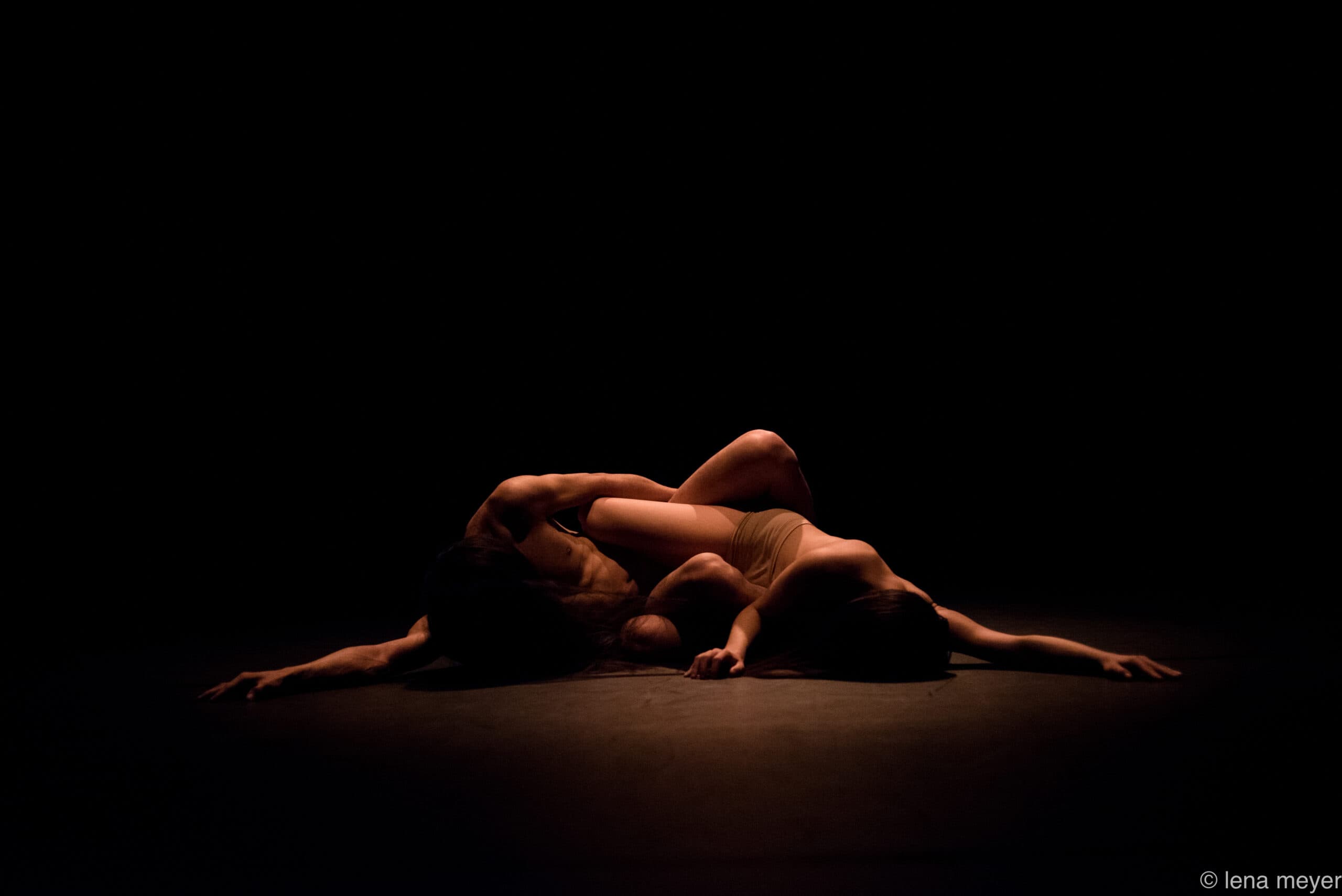
Still Water

AXEL WANG:
I asked our friend Lico this question about repetition before. Most of the time, performances are repetitions, and so are the practices and rehearsals.
MOTOYA KONDO:
We repeat the same choreography for each performance, and repeat the same performance over the years.
“I see myself more as a mirror, reflecting the audience’s thoughts,
sensations, imaginations and emotions,
and ultimately the awareness behind those experiences.”
AW: Exactly, but with every repetition of the same performance, do you notice anything different?
MK: Oh, yeah, definitely. Well, I create performances in different ways. Twilight (2014), for example, the choreography is predominantly fixed, whereas in more recent performances like Lifelines (2022), while certain structural elements remain fixed, there’s ample space for improvisation.
Regardless of the approach, every time I perform, it’s a brand new experience. It’s not a matter of choreographed pieces containing more repetition than improvisation, even in the well-choreographed works, the dynamic changes with each performance, different images emerge, new experiences unfold, and factors like the venue, the audience, my physical and mental conditions on the day, the weather, and the environment — they all vary from performance to performance, I don’t feel like I’m merely repeating the same thing.

This just came to mind, though in a slightly different context, but when I was in Bali, I encountered four exceptional dancers, and one of them has been performing the exact same, less-than-10-minute dance called Kebyar Duduk1, nothing else but the same choreography, throughout his entire life. Until the age of 85, he danced — same dance, less than 10 minutes, every single time — he never created a new production or anything. Despite the apparent repetition, I’m more than certain that his dance has evolved and deepened over time. Through each repetition, there must have been something fresh and unique born from it.

AW: You mentioned the audience. I wanted to touch upon the relationship between audience and performer. I think we both agree that live performance is way more powerful. The audience becomes part of the performance, and in a way completes the performance. Does it matter to you whether you perform in front of an audience or if it’s an empty theatre?
MK: Definitely it does. Performance is something created together by performer and audience.
AW: Do you pay attention to the audience at all during a performance?
MK: Not like peeking at them to see if they like the dance. (laughs) But the presence of the audience remains vividly within my awareness at all times. The energy from the audience significantly shapes the overall atmosphere for dancers on stage. In contrast, performing in an empty theatre is completely different.
In my view, a performance reaches completion, as you mentioned, through the audience’s presence, their imaginations, perceptions, and feelings, these are also crucial ingredients of the work. Particularly in mine, my intention isn’t to convey a specific message with hidden meanings or explanations to the audience, alternatively, I aim to encourage them to actively engage with their imaginations. I see myself more as a mirror, reflecting the audience’s thoughts, sensations, imaginations and emotions, and ultimately, the awareness behind those experiences. The audience, through the performer, sees themselves.

AW: We first met each other in Berlin in the summer of 2017, when I found out about your collaboration with Hoshiko Yamane (山根星子), and I became very intrigued by her work and especially, your collaboration.
Although dance and music seem like a perfect couple on the surface, it doesn’t happen often enough for a dancer to collaborate with a musician on such a long-term basis and vice versa. Can you tell me a bit more about this collaboration? How do you feel your works complement one another?
MK: I don’t know if I’m answering your question directly, but there’s an interesting anecdote behind it. When I first moved to Berlin, I was working with Tiziana (Longo) back then, and together we began performing in the city. During one of our very first performances, we were completely unknown, obviously, and I think only four or five people attended, and Hoshiko happened to be in the audience.
After the performance, we spoke briefly, and Hoshiko introduced herself as a violinist, and that was pretty much it. Then we all got on with our lives without much contact or knowledge of each other’s activities. But somehow, maybe two or three years after that first exchange, on one occasion — I don’t recall the details — but we started entertaining the idea of performing together, and so we did. From this very modest and almost serendipitous beginning, our collaboration has continued to this day…
(One of Motoya’s students arrived, and the conversation resumed after a short break.)
MK: Yes, sorry. As I was saying, from a very brief and humble beginning… I get the feeling that my life has always been like that, and I imagine everybody else’s may be somewhat similar — it often begins with the smallest seed. When we created Twilight, at first, Tiziana and I were just selecting music from published sources. But at some point, we invited Hoshiko to compose original music for the performance, and the end result was utterly remarkable. I was like wow, I was blown away. It’s been almost 10 years since we’ve collaborated.
Initially, it was more like she was playing music in the background, while we performed. But now our current approach is more akin to the dynamic of, let’s say, Flamenco. There’s a guitarist and a dancer, one-versus-one. It’s not merely background music accompanying a dancer in the foreground. I think this is what I’m experimenting with our collaboration at the present stage — one body, one violin, one-to-one. I’m searching for a way to cultivate a heightened resonance with the music, not in the manner of my body moves, follows or dances with the rhythm of the melody… When Hoshiko plays the violin, the sound becomes almost like a tangible substance touching the skin, the sound is not merely auditory perception, it reaches beyond the ears to resonate with the entirety of skin, bones, and body.

There’s a great Noh Theater (能 / のう) performer named Hisao Kanze2, who passed away more than 40 years ago. He once wrote that, in Noh Theater, while it may lack the gorgeous melodic lines that characterise Western music, it possesses a profound presence within a singular sound. This one singular sound, offers something Western music may not fully encapsulate — and that is what I search for in my dance.
Instead of crafting countless dazzling movements, and amusing the audience with graceful flowing lines, my pursuit is for something less — a singular movement that exudes greater presence, impact and intensity in my dance. The same thing can be said for the music; we search for fewer melodies but find full richness and presence within a single sound played by Hoshiko. That is something we are looking to experiment with.
Every time before rehearsal, Hoshiko and I would sit down together for tea, and we would talk, much like what we are doing now. There’s one time while we were having some Japanese wagashi (和菓子) — each piece looked almost identical, and yet subtle differences emerged in colours and patterns, and we just said: “Let’s try this today.” For every performance, we essentially maintain the same structure, but each sound is played with slightly different layers, and we follow wherever that may lead us.
AW: Is Hoshiko’s performance in Lifelines also improvised?
MK: We share some specific images or structures collectively. When Hoshiko performs, I think these days she uses a loop machine to cover 25 different sound layers or so, she said, actually, it’s not possible to compose and replicate the exact same performance every time. So yeah, each rendition involves significant improvisational elements.

AW: Another collaborator of yours, whom you mentioned earlier, is Tiziana. You founded Motimaru Dance Company together in 2010 in Tokyo. After more than a decade, you decided to part ways and head in different directions.
MK: The evolution was quite a natural progression, I think. We worked together for around a decade, as you know. She was, of course, an immensely important collaborator during that period. We both learnt a great deal from each other, and our influence on each other’s artistic perspectives was substantial. Sharing the same mentor meant we shared the whole connected vision on a very deep level for more than 10 years.
However, over time, we slowly, slowly began to sense a shift — perhaps a moment that’s not so easily and precisely definable. After sharing this creative journey for well over 10 years, it felt like the right time to part ways. So yeah, it’s a very organic and natural process, I would say.
Footnotes
1. Kebyar Duduk is a traditional Balinese dance style that combines dynamic movements with the dancer sitting cross-legged. It is characterised by expressive gestures and intricate footwork, and is often performed to accompany traditional Balinese music.
2. Hisao Kanze (観世寿夫, 1925–1978) was a renowned Japanese Noh actor and performer, belonging to the Kanze school, a prestigious Noh tradition. He has dedicated his career to preserving and advancing the art of Noh theatre, contributing to its cultural legacy.
Credits
Editor: Axel Wang
Photography: Courtesy of Motoya Kondo