
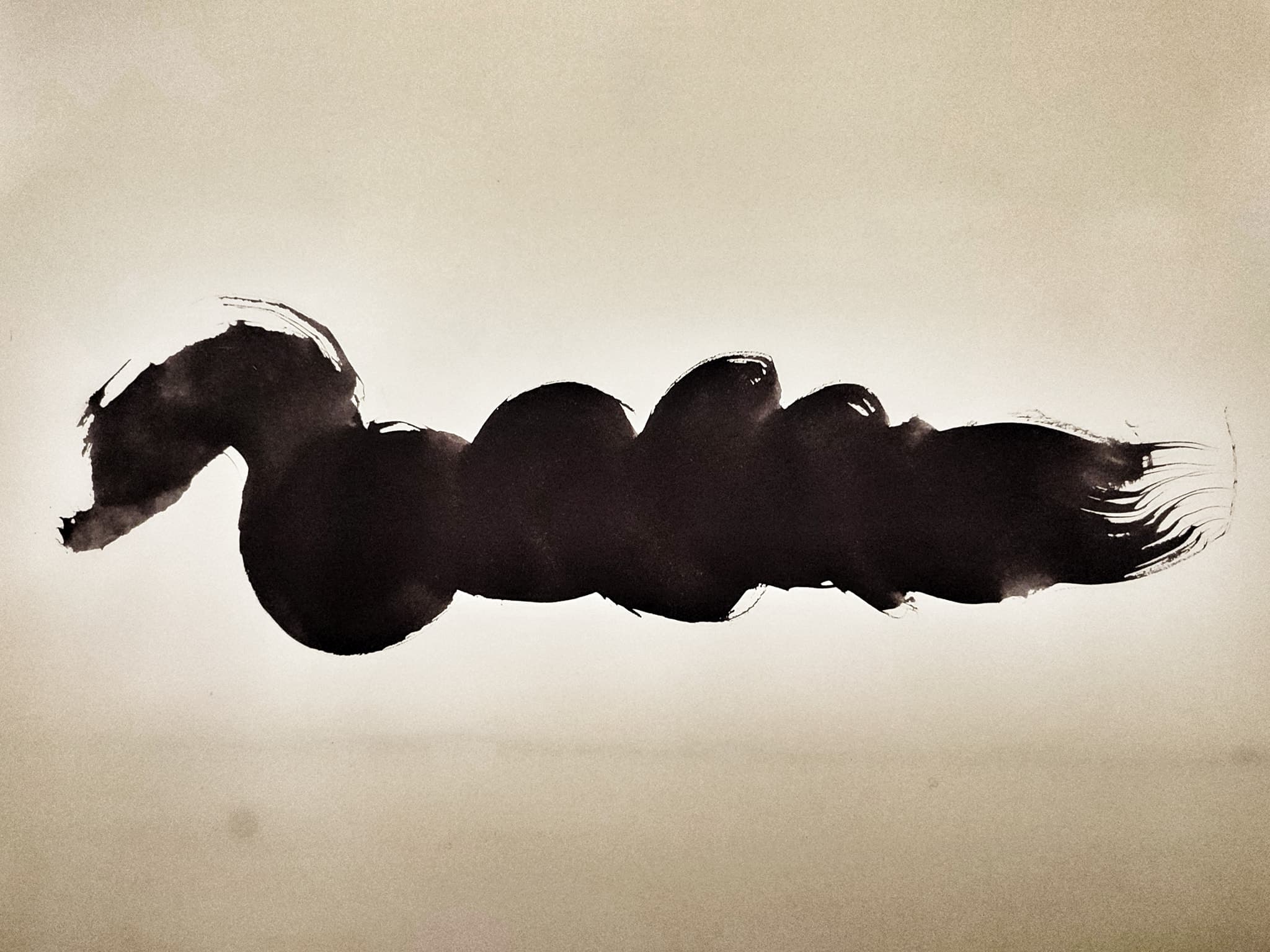
The Alchemist

AXEL WANG:
At the beginning of our interview, we talked about the Japanese way of things. Do you think you’ve gained a better understanding or a different perspective of Japan because you moved away from it?
MOTOYA KONDO:
Yes. I mean, my awareness of Japanese cultural identity started to emerge when I was living in America during high school, as we discussed earlier. That was definitely the first trigger. After living in Germany for 10 or so years, I think I became more aware of the Japanese culture and history.
Whenever I have the opportunity to come back to Japan, I’m always on the lookout for inspiration, something I can learn from this country — paintings, ceramics, anything. Currently, I’m most inspired by all these old Japanese works, which I think are also extremely experimental. I visited Ryōanji (龍安寺)1 in Kyoto (京都) recently, the stone gardens there are a marvel of sophistication, surpassing many contemporary installation arts that I see today. It’s incredible to witness such creativity from 500 years ago. I don’t know whether my feelings stem from being outside of Japan… and it’s not necessarily because of my Japanese identity either… Perhaps, it’s simply sparked by my keen interest in the art.
It saddens me to read texts from the pre-Meiji (明治) era, that the art and spirituality of old Japan were so profound and enchanting, there’s a poignant sense of loss in our contemporary times. The transition, or evolution, from Edo (江戸) to Meiji marked a pivotal wave of Westernisation and modernisation, and post-World War II, the influence from America continued this transformation. Throughout the entire process, I felt that we may have lost that connection with the spirituality and art that was once consistently nurtured and cultivated on this land.
Although I’m in a phase of rediscovering all these phenomenal things in Japan, it’s never an attempt to brag about the greatness of the nation, or to promote some kind of nationalist agenda. You see, my workshop participants and audiences are from all corners of the world, when I share thoughts about Japanese culture during the workshops, it’s futile, isn’t it, to merely emphasise the greatness of Japanese culture. Rather, it’s about sharing something universally inspiring that I’ve come across here in my homeland — a treasure that surpasses borders and hopefully enriches your artistic endeavours and inspires even more people.
AW: Do you think you might be able to give an example of what is being lost?
MK: One of the many things, is probably what we were just discussing, the very idea of selflessness. In earlier times, people used to carry themselves with greater dignity and elegance, in that they weren’t living solely for personal fame or wealth.
I think this prevailing shift towards materialism in the mind does not only apply to present-day Japan but, by and large, to the world, where our values are predominantly grounded in material pursuits nowadays. Whereas in the past… well, I mean, there’s always darkness in human beings…
“… that’s perhaps my faith in life, resting on the belief that our fundamental nature,
for each of us, is absolutely pure,
absolutely pure and vast that it cannot be contaminated.”
AW: We would always have desires and greed.
MK: Yes… I mean, I should never idealise or romanticise the past. I’m sure there were similar challenges, just like today. Nonetheless, whenever I read texts written in the past, it’s evident that there was once a more noble and selfless way of life. People dedicated themselves not for personal gain or fulfilment, but for something higher, exceeding the self. Unfortunately, this spirit seems to be diminishing in our time.
When I was in Kyoto not long ago, I visited the emperor’s villa, called Shugakuin Imperial Villa (修学院離宮)2. It turned out to be surprisingly simple and humble, it’s not like an extravagant, luxurious palace full of gold embellishment, you know, there’s a rice field, three wooden houses, almost merging with the surroundings. It’s like an expression of humility towards nature. I felt that, at one point, this country cherished the wisdom of valuing something greater than oneself. On the other hand, this sort of spirituality seems to be waning in our present day, almost as if we are only capable of appreciating things that are visible, quantifiable or tangible.

AW: When the pandemic first struck, you were in Nepal. What was it like over there?
MK: Initially, my plan for Nepal was a brief one-month stay, however, a week before my departure, the pandemic hit, with the lockdown and the airport closing, my plans had to change. During this time, I was fortunate enough to meet a teacher, and I continued my study and research of the Tibetan language and Tibetan Buddhism. I did that for around a year and a half, I think. Every day, a group of three or four students gathered at the teacher’s house, and we would learn about ancient texts. The teacher also had to look after his mother, who had Alzheimer’s, during the class. There was ongoing construction nearby, and every once in a while, a stinky dog wandered in… So it wasn’t like I was studying in a serene monastery, if that’s how you imagined! (laughs)

Following this period, I went up to a mountain in Nepal called Yolmo, and spent around 4 months there for my practice. For the first two months, I was living in a cave, where I had to gather wood to make fire. There’s an old lady who lives 15 minutes away, and she lent me a pot. Once a week or so, she’s kind enough to bring me vegetables and rice, so once a day, I would use this pot to cook rice and whatever vegetables had been gifted to me, and seasoning with salt and masala spice. On a luxurious day, I would also put a soft poached egg in it, which was pretty much my everyday life then. Material conditions were extremely elementary, but my mind was very fulfilled.

AW: That must be so enlightening. Obviously, you are in Japan right now, everything is convenient, and you don’t have to start a fire by yourself anymore. This transition in lifestyles is crazy. I can’t even fathom what your life was like in the mountains for four months straight.
MK: Well, only two months, I lived inside the cave, to be precise. After that, the rainy season started, so the cave was a little bit too humid to live in. During the following two months, I went out of the cave…
AW: You went out of the cave! (laughs)
MK: (Laughs) Literally, I did yes… I then moved to a stupa, it’s kind of like a place of worship, and the locals offered me to sleep inside and three meals a day without asking for anything in return. While I was there, I was practising Buddhist meditation, and some movement practices.

AW: Well, obviously, the pandemic is over now, are you feeling more positive, or did it never really bother you?
MK: I mean, in terms of my life, there haven’t been that many changes. My routine of researching and practising remained consistent during the pandemic. The circumstances of the pandemic offered me a lot of time to focus more on input, as I couldn’t perform or teach, so I dedicated time solely to learning and practising.
Post-pandemic, my output work has resumed. Although the pandemic altered the balance between input and output, providing a rich period of learning for me, I am now delighted to share with others what I learnt. While the world has definitely changed on a global scale, on a personal level, be it in a cave or now here in my house in Nagoya, of course, the environments and specifics are different, but for me it’s kind of the same, because the majority of my daily responsibilities essentially remain unchanged — keep researching and practising, then sharing it with others.
AW: From some artist and designer interviews that I’ve read, they talked about their reasons for continuing to create. Some said ego, some said passion, and some said it’s about passing on values to future generations. You have hosted many lessons and workshops over the years, and I consider that passing on the baton in all aspects. The students who study under you, are they mostly professional dancers?
MK: Not really. There are some, but more frequently, the professional dancers are not necessarily the ones who do the most interesting things, in my opinion.


AW: Why do you think that is?
MK: Perhaps training professionally in one particular manner can pose some sort of hindrance. The knowledge and experience gained might occasionally obstruct the kind of experience that I try to introduce. While a well-trained body is undoubtedly helpful, it may also become an obstacle. Both aspects are important, of course, having a trained body and the ability to adopt something new. And professional performers often may also have too much intention to “perform” rather than to “experience”.
At the end of the day, whether you are a dancer or whatever, it’s important to remember that we live our lives every day. The key lies in tapping into this generous well of experiences that our bodies and minds accumulate through everyday life. If we can successfully translate this inner richness into movements, or even more fundamentally, manifest it as a presence on stage, everyone can create something beautiful that touches people, whether you are a professional dancer or an amateur, it doesn’t really matter.
AW: You mentioned converting this house that your father built, the EGGCOSMOS, into a semi-dance studio.
MK: Concretely, my plan for now is to offer workshops and, potentially, at times, performances here. And yes, my broader intention is to transform it into a hub where people from diverse backgrounds can come together, to engage in thought-provoking conversations, foster creativity, and experiment — a crossing point of perspectives and ideas, that’s my wish.


AW: Final question, Motoya-san. You once said that you went to all those places searching for an answer to the question of how dance and art can contribute to the world. After all these years, have you found the answer?
MK: Yes, I believe so. I mean, describing it as “contributing to the world” might be a bit exaggerated (laughs), even though I said that once, and that was genuinely what I had in mind. Perhaps we can simplify it by asking, what should I do as an artist, as a human being?
For me, the essence and ultimate purpose of art and dance is to unveil reality, the truth of one’s existence. This truth doesn’t always carry notions of darkness, heaviness, or hopelessness, as if the world is doomed and we are all fucked and so on. No, not in my mind. I believe that the deepest truth, the reality, is somewhat relieving, liberating, and luminous, that’s perhaps my faith in life, resting on the belief that our fundamental nature, for each of us, is absolutely pure, absolutely pure and vast that it cannot be contaminated.
Through art, we have the opportunity to re-establish a connection with the radiant and luminous space within our bodies and consciousnesses, utilising this inherent resource that each one of us possesses. However, due to the “sunglasses” we tend to wear, this reality often eludes us, and we crunch and reduce it into minute fragments, seeking fulfilment externally instead of recognising the wealth within ourselves. My wish is to make dance a path towards reconnecting with the abundant, innate resources of the body and mind, which are absolutely pure and boundlessly vast. That’s my view. Now, I need to practise every day to fully realise it experientially.
Footnotes
1. Ryōanji (龍安寺) in Kyoto is a Zen Buddhist temple known for its iconic rock garden, featuring 15 carefully placed rocks amidst raked gravel. The temple represents a masterpiece of Japanese Zen art and provides a serene space for contemplation
2. Shugakuin Imperial Villa (修学院離宮) in Kyoto is an imperial residence with extensive landscaped gardens and teahouses, designed during the Edo period. Renowned for its scenic beauty and meticulously planned layout, showcasing traditional Japanese architecture and garden design.
Credits
Editor: Axel Wang
Photography: Courtesy of Motoya Kondo, unless otherwise stated.