
Shuhari 守破離

AXEL WANG:
Butoh is often interpreted as dark and distorted. Motoya-san, do you see darkness in your art?
MOTOYA KONDO:
For me, what I aim to do, is to confront the totality of life, acknowledging not just its brightness but also its shadows. When we examine our own lives, they have two sides, don’t they? Both life and death coexist. As witnessed in my mother’s journey, life appeared relatively stable and fine, yet with the sudden intrusion of illness and ultimately, death, the unavoidable facets of reality, such as sickness, death, and darkness, all emerge as inevitable dimensions of our human existence.
Therefore, I firmly believe the question lies not in categorising Butoh as either dark or light, but rather in recognising the complexities and totality in our lives. Whether we want it or not, we often find life encompasses more than just moments of brightness and joy. The presence of darkness is intertwined with our existence, making it an integral and conspicuous aspect of life and, consequently, of my art.
And I also believe that art can embrace darkness as beauty. Hip-hop, for example, often channels the anger and violence prevalent in the circumstances of African American people in the US. Such energy could potentially manifest destructively. Nevertheless, when expressed through music, this anger undergoes a transformation into a creative force. Similarly, Flamenco, while unquestionably exquisite in its form, harbours shades of darkness and struggle, exhibits emotions like love and hate, desire and anger — the art form harnesses such energy so creatively. And let’s say comedy, comedians mock and make fun of the darker aspects of existence, turning that dark energy into laughter.
So I think that’s a very fundamental aspect of art, to embrace and transmute the dark side of existence, and it extends far beyond darkness alone, incorporating a much broader spectrum — joy, happiness and love, they all coexist within this realm. In my art, I don’t specifically fixate on the darkness of existence, instead, I seek to explore the totality of existence — lightness and darkness, love and hate, life and death. Confronting this totality is central to my work. And ultimately, I have faith in the absolute light that exists beyond the duality of light and darkness.

AW: In essence, do you think that’s what Butoh is about, the totality of existence? Say, when you host a workshop, how do you explain to your students what Butoh is?
MK: I avoid so rigidly defining Butoh. Instead, we look at the works of Tatsumi Hijikata (土方巽) and Kazuo Ohno (大野一雄), to understand the remarkable qualities, while also bringing critical points of view where necessary. In Hijikata’s work, perhaps there’s a particular focus on the darker front — sickness and death.
“I am driven toward a different objective, the opposite —
to express or manifest selflessness on the stage.”
AW: That’s probably where most people got the impression from — Butoh being very monstrous and creepy.
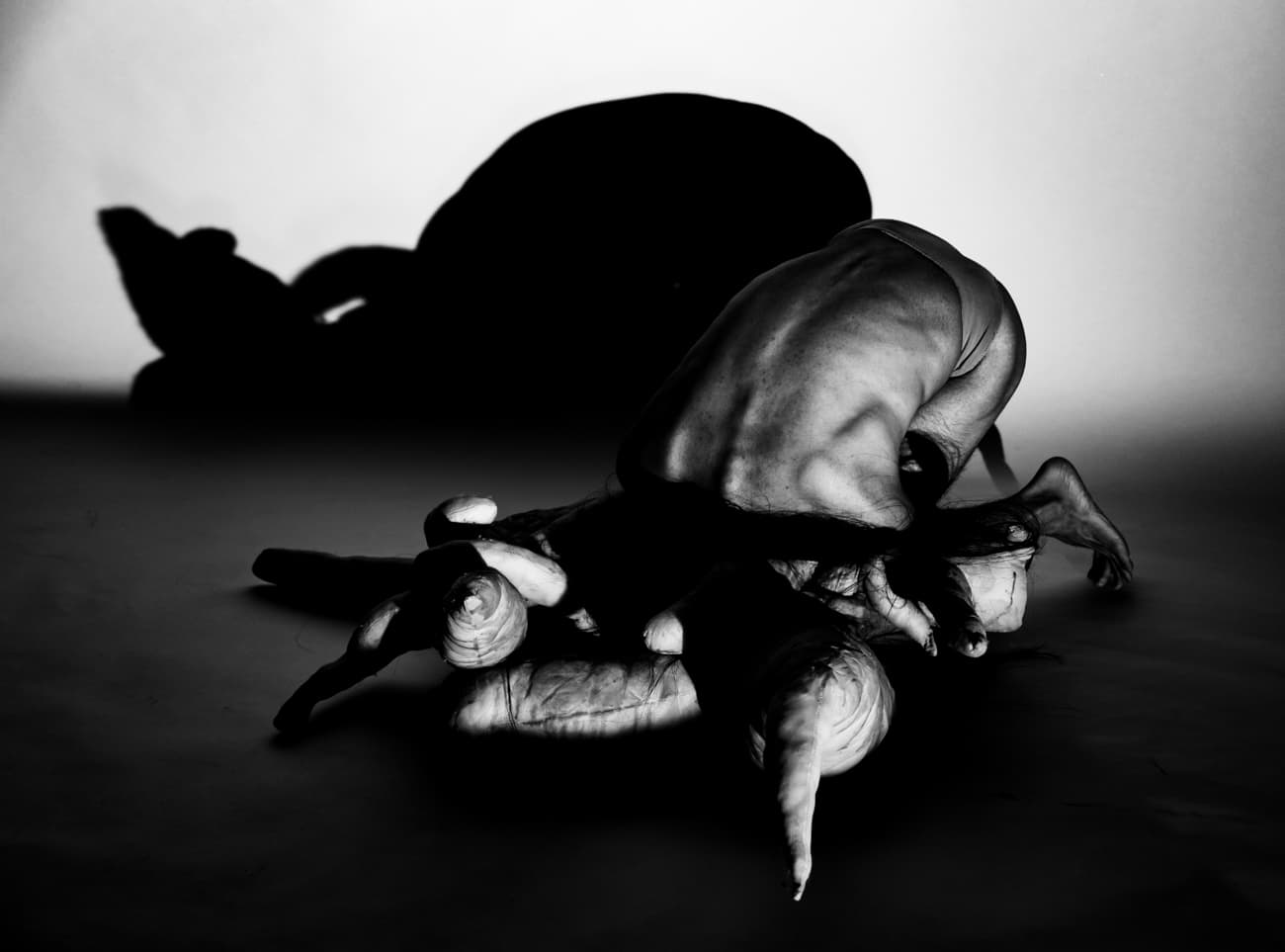
MK: I believe his emphasis was intentionally directed to that part of reality, however, one thing we should be careful about in our interpretation is that, Hijikata wasn’t merely vomiting out or projecting his personal issues onto the stage. Alternatively, he embraced the dark side, like I said, as a form of beauty and even elegance. I also sensed a great amount of humour in his work, frankly — it’s not always so serious and dark — the manner in which he engaged with and found enjoyment in darkness… His darkness shone so luminously on stage.
You know, if we merely portray darkness as itself, it holds absolutely no meaning. Conversely, if we succeed in presenting, for instance, faeces on stage as flowers or something elegant, that becomes intriguing for me. This may apply to Butoh, contemporary dance, painting, whatever. At times, I would find artworks that present darkness and grotesqueness without offering any new perspectives, in such cases, one may question the significance and purpose of it all.

AW: In many of your research papers and the conversations we’ve had so far, “reality” is a word that comes up often. I’m curious, what do you mean by “reality”?
MK: (Silence) Before talking about what the reality is… it often occurs to me that, our everyday lives pass by so quickly, without us even realising who we truly are and who others truly are — that’s the state of our lives somehow… I recall an incident when I returned home with my father one day, and we were in the kitchen, my father said to me, “Hmm, the kitchen is very dark, what happened today?” I looked at him and said, “Father, you are wearing sunglasses.” He then removed them and said, “Oh, now I see!”
This scenario, in a way, mirrors our state of life, doesn’t it? As if we are constantly wearing sunglasses and shaping the perception of ourselves and the world through those tinted lenses. Only when we take the sunglasses off does a clearer view of ourselves and our surroundings unveil. That’s what I meant by the reality.

AW: You said before that Buddhism is perhaps your biggest inspiration throughout your life and career. In what way does Buddhism inspire you?
MK: Buddhism has been dedicated to researching the reality of existence and truth — “sunglasses-off”, essentially, for well over 2,500 years, generation after generation. In my view, Buddhism also aligns with the purpose of art, to take off the sunglasses through which we perceive ourselves and the world, and to reveal the naked truth of our body and consciousness, and therefore the truth of the whole world and our reality.
And that’s what I particularly value in Hijikata’s work, where he presented so many distorted elements in his works, acknowledging our human conditions. Because if we look into ourselves closely, into our bodies and minds, we find asymmetry, imperfections, and complexities — we are not only pretty and joyful beings. The distortions, twists, and cracks are all parts of our lives, a universal condition shared by everyone, including Hijikata and me.
Hijikata’s approach involved confronting all these distortions, revealing the conditions of our body and mind and simultaneously, embracing them all as a form of grace, instead of discarding or ignoring them. At the core, Hijikata himself stated that Butoh is, or art itself, is the exploration of human existence. His method wasn’t purely intellectual or philosophical, but thoroughly experiential, because for dancers, interesting thoughts and philosophies must be fully embodied on stage.

In many ways, the Buddhist tradition has long engaged in researching the very existential questions, and the depth of this exploration has stood the test of time. Not only through extensive philosophical sophistication, discussions and development, there’s also a methodological dimension, sometimes people refer to this as meditation, which is a practice aimed at exploring and understanding this existential reality in a more experiential way. Over the course of 2,500 years, Buddhism has accumulated an immense wealth of knowledge and experience in this pursuit, for me, that’s an extremely valuable resource.
But umm, when I use the term “Buddhism”, very much like “Butoh”, there is often a divergence between what people associate with the term, and its true essence… More often than not, I hesitate to use these terms simply because they may or will evoke perceptions of a belief system or religion. Yet for me, it transcends those connotations. Like when people say, “Oh, Butoh has nothing to do with Buddhism” — I’m not really sure what they meant by “Buddhism” there, but it seems they might be expressing their thoughts based on somewhat of a vague or approximate image of the term.
My primary research and connection have always been with Tibetan traditions. The more extensively I dive, the deeper the connection I notice, between Tibetan Buddhist practice and Hijikata’s choreography techniques, as well as his training methodologies. Obviously, Tibetan traditions don’t utilise or realise them as an artistic form for presentation to audiences, but many of their methods are surprisingly similar. What is deeply suggestive in those methods in the Tibetan tradition, is that certain practices are reserved only for well-prepared and qualified students, taught by qualified teachers, as the associated risks are clear, the purpose of the practice is well-defined and actually very refined.

AW: Your workshops and lessons aren’t about dance only, but also the practice of the mind as well, is it like meditation?
MK: Once again, I prefer not to use the word “meditation” as it might lead to potential misunderstanding. But the focus of the lesson is really about the practice and the exploration of the reality of the body and mind. And such exploration extends beyond mere intellectual investigation. Ideally by the end of the process, it helps participants create compelling art while also having a positive impact on their everyday lives — these must come together in synergy. If a particular practice only contributes to artistic innovation but compromises mental well-being, that’s an outcome to be avoided at all costs.

AW: Coming back to Buddhism, there is this idea of anattā, meaning “selflessness” in English, and “muga (無我)” in Japanese. You strike me as a very selfless person, Motoya-san.
MK: Or maybe you just don’t know me enough. (laughs)
AW: Probably, probably. It’s only an impression, I think “undistracted” may be a better word here.
MK: I can surely say that Buddhist practice has helped me, helped my life, greatly. Even though I have not fully comprehended the depth of selflessness at this phase, when I reflect on my past and present, I find a significant shift. Comparing my current state with my younger years, I definitely find it more at ease and more joyful to live each day. My life has been greatly enriched by my research into Buddhist philosophies and practices.
This intuition of selflessness holds great importance in my artistic pursuits. Contrary to self-expression, I am driven toward a different objective, the opposite — to express or manifest selflessness on the stage.
AW: That’s interesting, because when one thinks about contemporary art, it’s mostly about self-expression, but you are trying to achieve the exact opposite, the expression of selflessness.
MK: Yes, that is what I’m searching for. It might be more accurate to say that the more we see and understand the depth of oneself, the more we understand selflessness.
Credits
Editor: Axel Wang
Photography: Courtesy of Motoya Kondo