
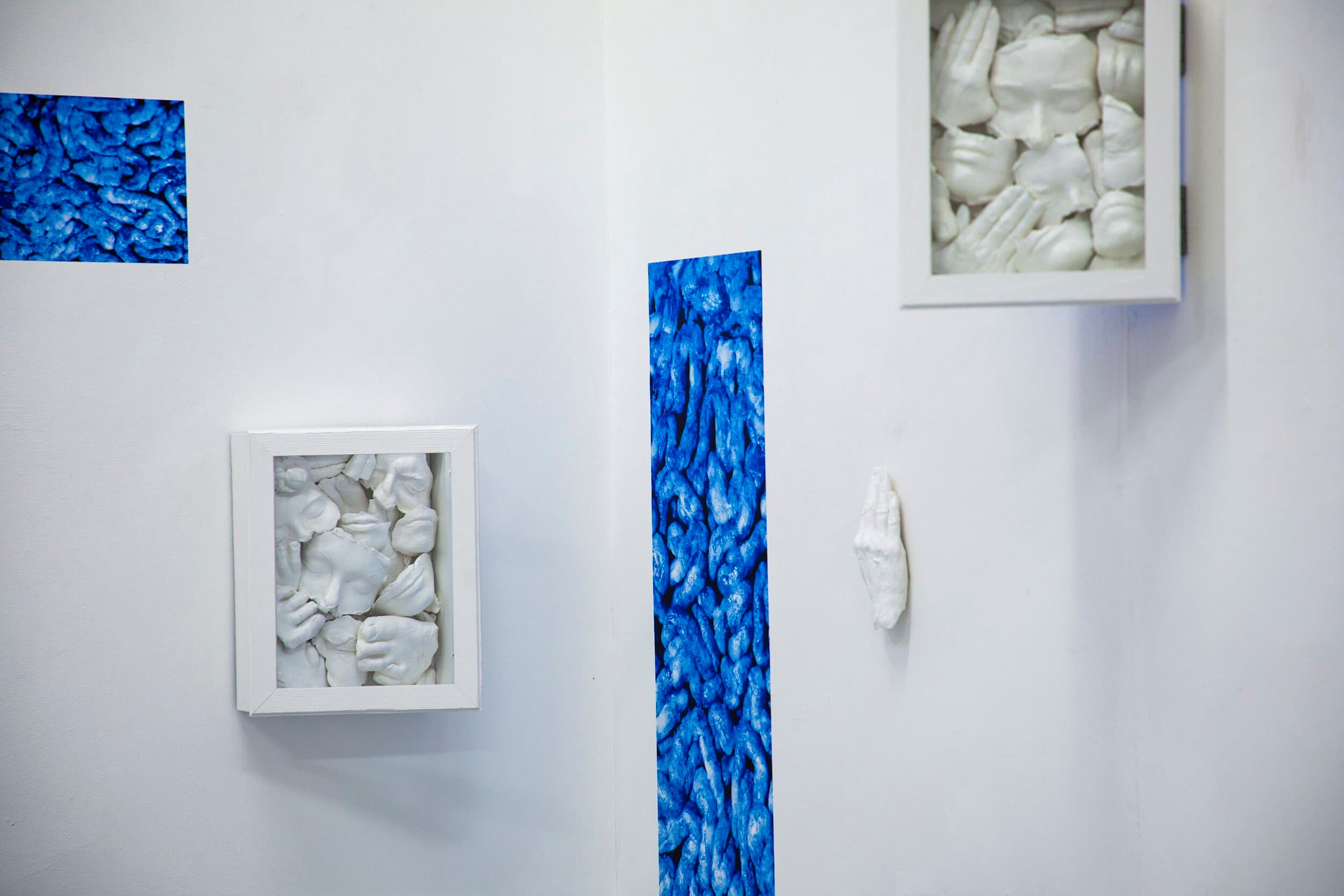
Body Farm
AXEL WANG:
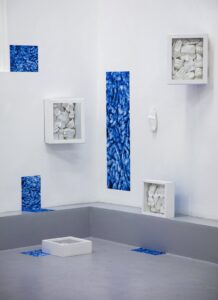
With your arrival in London, this ultimately would lead to your work Body Farm (2020). In one of your earlier interviews, you said that, when your flight landed, you found every cast of the work shattered in the suitcase, except for one. That must be devastating.
LOREAL PRYSTAJ:
Oh, my gosh, if only I could describe to you what that work went through.
After university, I had this opportunity to exhibit at Lewisham Arthouse in London, as part of Pic.London. Before the exhibition, I returned to the US to teach at a summer programme at Yale. Honestly, I had no idea what I was going to exhibit or where the project was heading, I was just obsessed with body casts at the time, so while visiting home, I created casts of my whole family, from their faces to their feet — everything.
Without much forethought, perhaps I should have given it more thought — I just filled a suitcase full of body casts to bring with me to London, assuming that shipping all the pieces would be too expensive. I don’t know if you know this about plaster, Axel — it remains porous and wet for about a week and a half after sculpting, maybe longer, before it is bone dry. So, this suitcase was full of these plaster pieces, which I brought from Upstate New York to Manhattan, packed in this dark case, a week before heading to London.
I remember, while I was staying with my friend in Brooklyn, I was like, “Does it smell mildewy in here?” She was like, “That smell is coming from your suitcase!” And I was like, “Really?” (laughs) So, I opened up the suitcase. Now, this was before the pieces even broke, but they were covered in mould! It was growing all over, inside the suitcase — I thought they looked pretty cool, but oh my gosh, there was mould everywhere — it’s a health hazard, and I had to get rid of it. Washing them would essentially mean reacquainting moisture with the porous pieces, and it was just a complete disaster from that point onward. I figured I’d just deal with it once I got to London.
Anyway, I packed and zipped them up in the suitcase as check-in luggage. When I arrived in London and opened this stinky, mildewy-smelling suitcase, they were all mouldy and broken, and I had two weeks to come up with something for these darn things. I dried them out and wiped off the mould, and as I looked at them — all broken and shattered — I just had no idea what to do with them.
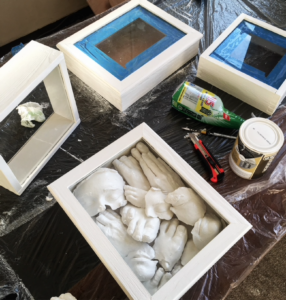
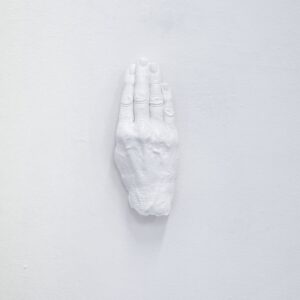
At the time, I had these wooden shadow box frames in my studio. Out of curiosity, I placed some of the broken body casts inside the shadow box, and wow, it started to become this reliquary-like object. At first, I was just half-joking to myself and laughed, under this state of what-the-heck-do-I-do, a reliquary of my family’s body parts, that’s just so funny, how much more morbid can we get here?
But then I thought again, and there was this “light bulb” moment, after a series of discussions with my studio mate at the time, about reliquaries, memory, and ritual, she brought up body farms, one thing after another flowing through thought and conversation, and actually, I loved it. Brilliant! — This is exactly what it is.


What is it, that a reliquary retains? It’s an archive of sacred memories… full of relics. This resonated with me. I visited my family, where I grew up; memories resurfaced; and there I was, metaphorically bringing my family (memories) with me to London. The casts turned into this farm of their fragmented body parts. How did they become fragmented? They became fragmented because I decided to leave where I grew up, I decided to cross the pond and tried to bring them with me. My travelling from New York to London suddenly became this symbolism for memory… and no matter how hard we try to hold on to it, it inevitably becomes more and more fragmented; as the hours, days, months, years pass — it’s always fleeting. It’s always changing…
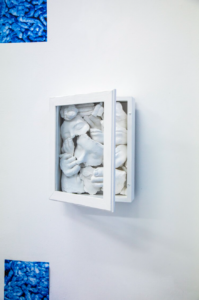
AW: It does add a whole new layer of connotation to the work, I must say, with the casts being broken. Like you just described, nothing is permanent, not even memories. Everything fractures, and the fragility of it all, and eventually they may end up being fabricated in some sense, but still, I couldn’t imagine how you must have felt when you first saw those shattered pieces. If I were you, I would’ve just sat there and cried.
LP: You know Murphy’s Law? Anything that can go wrong, will go wrong. There was a certain point where everything with this project, literally… went wrong. I remember the moment I opened that suitcase, I was like — of course, of course, they broke, not that I want to present myself as being happy during that experience, because it was quite the contrary when I saw them all broken, but it’s like a peculiar acceptance. I could only laugh at that point — of course, they broke. Of course, what’s next?!? (laughs)
AW: You’re still living in London after all these years. If you had to compare it with New York, the Concrete Jungle, the people, the culture, your everyday, how are you finding everything there in London?
LP: I love London. I love London so, so much. I really feel it’s my home currently, I say that in the sense that it’s a place very aligned with who I am at present. I like the city’s access to different parts of the world, to culture, to a lot of people coming from all over. What’s similar between London and New York is that they are both cities, which attract people who are inspired and determined, resulting in engaging and rich interactions and deep conversations. There’s something dynamic that exists in both cities on many layers.
One thing I love about London, and that I didn’t find existed in the way that I desired in Manhattan or Brooklyn, is the distribution of parks! London has an amazing amount of nature despite being a city — and that’s why you can see creatures running around, like foxes!
On the other hand, I went back to New York last summer, and there’s a certain quality I’ve always loved in the people living in New York that I don’t necessarily find all the time in London. You know, New Yorkers may have a reputation for being perceived as “rude”, but having lived there, I’ve come to realise that this trait is more about an upfront, raw honesty than anything else. You know where you stand with people, there isn’t this “politeness” for the sake of being perceived as polite and nice, that’s not to say that New Yorkers aren’t kind — they really are. There’s just none of this, “beating around the bush”, or decoding mixed signals, like “What do they mean by that?” People just say exactly what they’re feeling when they’re feeling it. If someone likes you, they like you; If they don’t, you know it. Whereas I perceive, in London, there is a characteristic of composure and politeness, that feels like a mask to me. I find that I gravitate more toward raw honesty in people than just their composed nature for the sake of presentation — you know, this kind of being nice and polite for the sake of what others think. I have to say, sometimes I miss that rawness from New Yorkers.
With all that being said, I do personally prefer London and genuinely feel that my lifestyle is healthier here. London has an “off ” button — it goes to sleep — the tubes stop running, the shops close, the pubs and their “ding-a-ding” with the bells — last call for drinks before midnight! New York never shuts down, and I felt that was really draining.
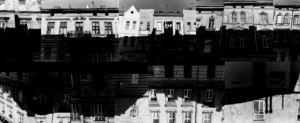
AW: After graduating from the Royal College of Art (RCA), you did a residency in Lviv, Ukraine. What was it like for you? Was it emotional for you to go and reconnect with your roots?
LP: This is such an interesting question. Okay, Axel, I have to give you a forewarning that we might go off on a bit of a tangent here, and this conversation may turn into another 5 hours. (laughs)
So, I was presented with this opportunity in Ukraine while I was at the RCA, and I thought to myself, why not apply? I would love to visit! I was totally unaware before I applied, that, Lviv is in fact only 20 or 30 miles away from where I still have family, my heritage, the city of Truskavets.
Lo and behold, I got accepted and wasn’t anticipating all these exciting things happening. Now, I think everything in the universe coincides with one another. You know how I mentioned earlier that I was visiting France with my partner? Well, there was a whole set of experiences that highlighted our growing in separate directions, and we broke up, around the same time I was accepted for the residency. That was in 2019, and I’m mentioning this because immediately right after that breakup, and after moving out, I was heading off to Ukraine.
In fact, I wasn’t feeling any emotional repercussions of our breaking up quite yet, because I was so focused on what to do next, and the work, that (emotion) came later. Nonetheless, my parents knew I was going through a breakup, and they decided to visit me in Ukraine, to just be present with me and share time together, since they were under the impression that I was sad and I was grieving. Again, I was emotionally removed from the breakup until later.
If it weren’t for the breakup or that specific context, my parents would not have visited me. I have been to other residencies, and there have been no visits. So, this life experience I was going through — this breakup — became the catalyst for my parents deciding to join me in Lviv during the residency. I could have been in any country, anywhere in the world, but I was in Ukraine, and they flew in from New York, which was one of the most magical moments for me.
And yes, I felt a lot from my roots in Ukraine, which was incredible. I spoke very little Ukrainian with my dad as a child, and was surrounded by his side of the family speaking it all the time. So, although I did not speak it fluently, I picked up the language rather quickly over there, as if it was re-emerging through me — like it was hardwired into my memory and body.
On the other hand, what was most profound to observe, was my dad. My parents are both in their seventies, and when I saw my dad there… it felt like the trajectory of experiences that led to my parents visiting was more about seeing my dad reacquainted with his roots. There can be this perception that as you get older, you get more stuck in your ways, grumpy, closed-minded, judgmental, etc., which has been talked about amongst my siblings about my dad. But when we were there, I saw my dad speaking Ukrainian, singing Ukrainian songs down the street, doing cheers with people in town, laughing — it was as though I saw my dad as his childhood self inside a seventy-year-old man’s body.
I was moved, to observe this person that I know — outside of the role of playing my father — and see him as a person being reacquainted with his roots. It was a reminder for me that sometimes when people are getting a little bit more rigid in their way, stubborn, judgmental, it’s not necessarily because of their age or getting older — it might merely be because they’re just in a place that they’re not aligned with anymore, for too long. Stuck in a place that does not serve to remember their true essence. I don’t think American suburbia serves my parents, I think they are just comfortable there. I mean, they were laughing so much in Ukraine, and sharing so many stories about when they first met, I will always cherish it.
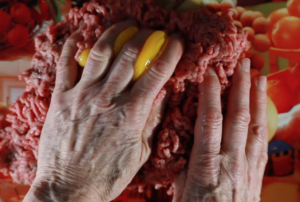
AW: That’s beautiful, Loreal. I was looking at your work, Have You Dined Sufficiently: Mother’s Meatballs (2019), and while I find the visual aspects strikingly unique and provoking, I’m more curious about the idea behind the piece.
Being born in the East, the phrase “I love you” does not really exist in our dictionary. I think I speak for most Asians when I say this, how our parents express love to their children is through things like, “Have you eaten?” or “What would you like for dinner?” — that’s their love language. Your piece somehow reminded me of that.
LP: Yeah, I think I can relate to that from my upbringing — this kind of love language that is the function of taking care of the family — are the kids fed? Are the bedrooms clean? Did you get your homework done? There is this whole aspect in the sense that they care for you, and want you to do well, but with all the practicalities that exist in the physical universe, perhaps not always in the emotional sense.
My mom is a very functional type of mother, you know, food is always in the fridge and she pushes us to achieve more, and do the chores. She’s a very reliable mother who would pick you up from here, drop you off there, etc. As I’ve gotten older, I’ve come to recognise that there are many qualities within me that are like my mom, and I accept and love that. Whereas in my teenage years, I was very much about my independence, “I make my own decisions”, “I don’t want to do that”, “Why would I listen to you (mom)?” I think many teenage daughters feel this way toward their moms.
With time, though, I’ve developed an affinity for my mother. I understand so much more about her perspectives and what she was going through, to act in certain ways, that I perceive we’ve gotten closer as I get older. Currently, I feel there’s something really special emerging regarding what that relationship will manifest into.
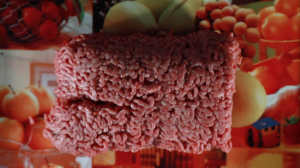
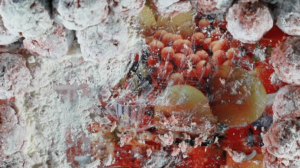
AW: You guys collaborated on the meatball piece, didn’t you? Is there another one on the horizon?
LP: Yeah, so when I was at the RCA, I was creating a lot of work within the domestic space, the meatball work included. Once again, I found myself disrupting these hospitable, well-manned environments.
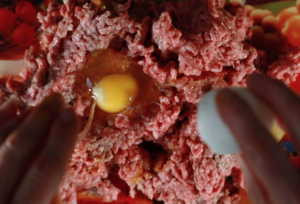
With this piece, in particular, it was about twisting the act of cooking — an act of hospitality — into this sensual and sexual act, and bringing those topics to the dinner table that are not often discussed, or are repressed within the domesticated lifestyle. I see the work almost like a follow-through or an extension of the narrative encapsulated within the broader sphere of my domestic work — from the wallpaper to the pussy lamp photograph, the flower vase, and so on.
Although it may not be wrong to label it a collaboration, since it was my mom making the meatballs, I always considered this to be the work involving my mom rather than a genuine collaboration. 99% of the time, I was directing this piece. Whereas right now, I feel we’re involved in a collaboration together because we’re in continuous dialogue with each other, we are working together and sharing ideas quite in-depth, and her input is so crucial for our current project. I see her as a true inspiration. Since she’s in the US, we are working long distances by shipping things back and forth. So yeah, it’s shaping out to be a really beautiful body of work — I am so excited, in fact, for when it’s ready to be revealed.
AW: Literally can’t wait to see the fruit. It doesn’t happen often enough, a collaboration between an artist daughter and an artist mom.
LP: Yeah, for now, I can’t really tell you what the end result will be, but I can definitely share how it started, it’s really been a whole intuitive, creative process.
From 2020 to 2023-ish, I had been recording my dreams and building an archive… while I visited my mom and the family last summer in the US, for the first time in three years due to the pandemic, it was emotional when we met. She was crying as we hugged, and from my perspective, I just perceived, oh, we haven’t seen each other for a while and that’s where these emotions are coming from. But to my surprise, my mom had been withholding information that she was waiting to share with me in person.
This was about a year ago, around August 2022, my mom looked at me and said, “Loreal, I have breast cancer.” You know those kinds of moments, where you hear the words, but they don’t quite sink in? I was just like, “What do you mean?” She started telling me about her check-ups, and how they (doctors) stuck this needle under her arm and injected a dye, which filled her lymph nodes in that area. She described them as enflaming and looking like a mound of grapes beneath her arm, and how painful it was.
She’s very much healed now, and if cancer were to be found, they found it in my mom, at the best time possible — in the beginning stages — which I am grateful for, but as I listened to her sharing this experience, despite me being in shock, I kept thinking to myself, “Why does this sound so familiar?”
Strange.
I started going down this rabbit hole of digging through my dream archive and found one recording labelled “grapes, tattoo artist, pyramid” or something like that. I listened back to the dream recording, in my sleepy voice, I described a scene where I walked into a tattoo parlour and saw a man in a white lab coat. I lay down on a bed and asked for a “natural” tattoo — whatever that means — from this artist. As he finished and I got up from the bed, I walked over to a mirror to look at my new tattoo. I then discovered that he had injected a dye under my arm by seeing blueish/purple bulges, which I described in the recording as a mound of grapes, under my arm. I looked at him, disturbed, and told him I wanted it removed from my body, and he said I would have to go through another procedure for that to happen — I was panicking in my dream. Then it took a bit of a surreal direction, as I looked at the mound of grapes, they started growing by popping down my arm until they met a mark on my hand — a triangle with an eye inside, and then I woke up. Anyways, that was the recording.
When I recorded the dream, it was honestly nothing significant to me. But after what my mom shared about her experience, this dream took on a whole other meaning. I shared the dream with her, which she expressed as sounding weird. Then I asked, “When was this procedure, Mom?” She responded, “End of July 30th or 31st (2022).” I looked at my dream recording and saw that I recorded it on July 31st, 2022.
AW: That’s pretty nuts.
LP: Yeah, I know. For real.
There were too many synchronistic and parallel occurrences for this to be a mere coincidence. And I thought to myself, first and foremost, how limited we are as humans to even have the slightest understanding of this — what we call life, is. What felt clear, and is clear, is that we are Nature and part of it.
I started to think about quantum entanglement and Bell’s theorem, the idea that if one atom splits and separates, what this atom experiences (gesturing with left hand), so too does this atom (gesturing with right hand) — aren’t we, after all, just a collection of atoms? Despite being a different individual, with different societal expectations, life experiences and influences, from my mom, I did come from her body — and perhaps my body has some form of consciousness that I am unaware of, trying to communicate with my mother — trying to heal her body, by sending me (itself) warming — like the way trees exchange signals and resources through underground mycelial networks, a phenomenon that has only relatively recently been discovered and studied by scientists in the late 20th century. Could this be a door opening, revealing that our bodies, like trees, communicate through some web in the quantum sphere that we just don’t quite understand yet, but know is there?
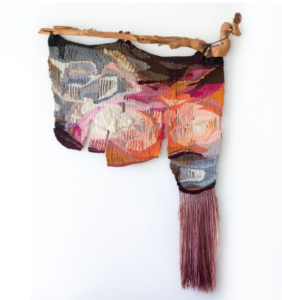
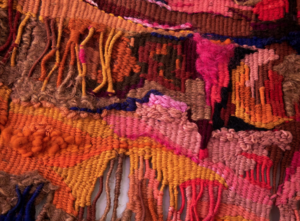
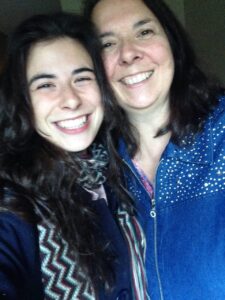
While I was going down this rabbit hole, I was in the house looking at everything a bit differently, and stumbled upon my mom’s magnificent artworks, they’re just under the bed collecting dust. These beautiful tapestry-like fibre pieces that look almost like landscapes from a bird’s-eye view. I thought, if there’s ever a time to collaborate with this talented person, woman, artist, my mom — it’s now! I immediately told her, “Mom, let’s work on a project together.”
It’s intriguing how, what initially began as a mother-daughter project, drawing parallels between the roles we play in that relationship, to similar narratives that can be found in nature, and connected to the body, has transcended to a deeper realisation that we are all interconnected and part of something profoundly divine. Combining our practises, from my sculptural and video works to my mom’s tapestry pieces, it’s evolving into something beautiful and unravelling in a wonderfully organic way.
The project has reached the point where it feels like we are working together, collaboratively. For so long, my mom has been programmed to serve others. What once started as, “Sure, Loreal, I can help you with your project”… slowly became, “Mom, no, it’s our project”, and at this point, she’s coming to me with ideas, which feels so amazing because it’s morphing into a proper collaboration.
Credits
Editor: Axel Wang & Loreal Prystaj
Photography: Courtesy of Loreal Prystaj