
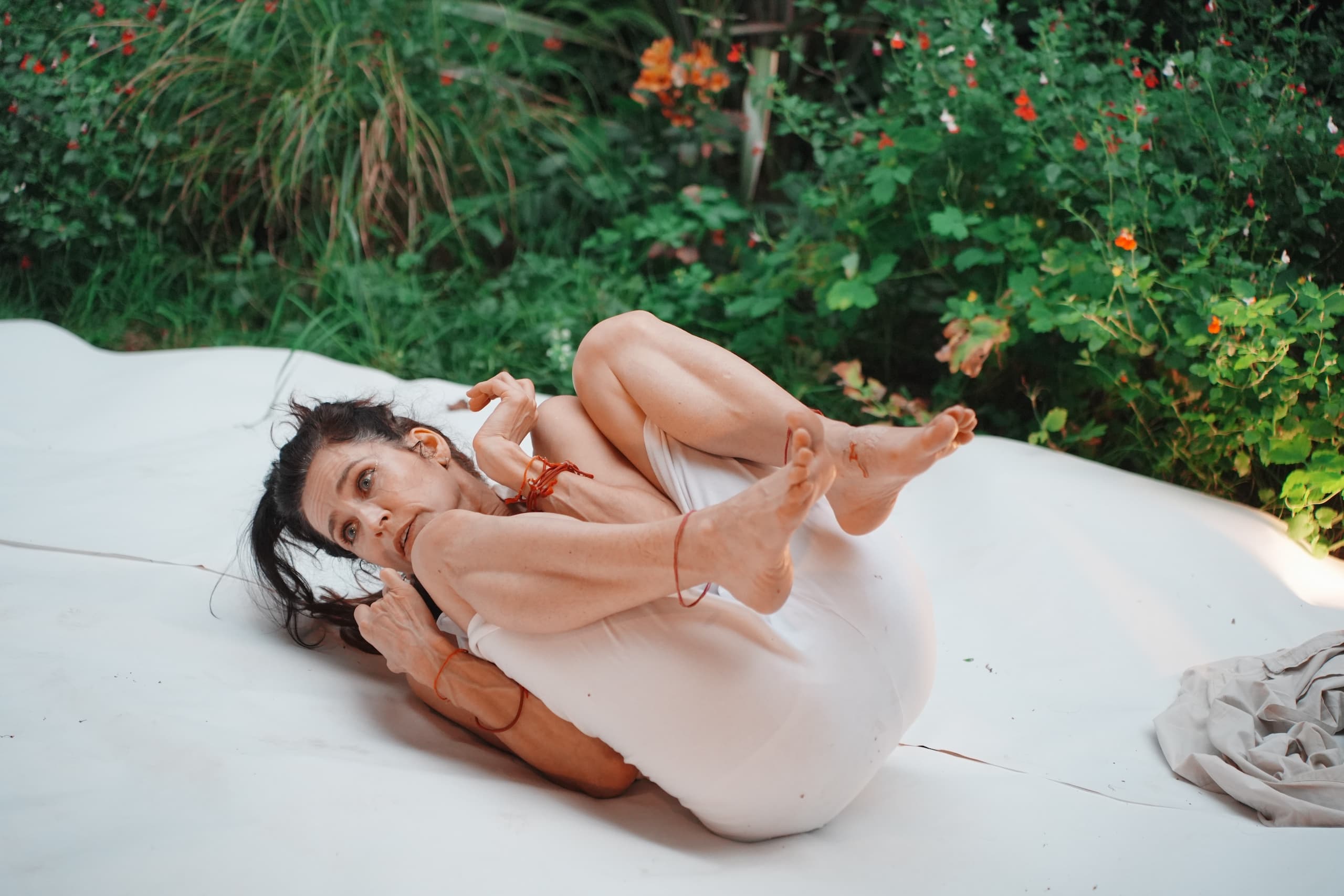
The Stranger

AXEL WANG:
Your sabbatical in Japan. You’ve been here for quite some time, right? Seven months? Are you planning to leave or planning to stay?
JOANNA ROSENFELD:
I have to leave.
AW: But you’re coming back.
JR: Yes, I am.
AW: You sounded a bit hesitant.
JR: No, but my daughter cried when I told her. She’s 19, and she’s about to go off and live her life, though she really struggled with me leaving. And she’s quite right. I’m going back for six months, then I’m coming (to Japan) again. I was actually in Berlin for a month before I came to Japan, so she hasn’t seen me in eight months.

AW: How has the whole journey, the whole experience, influenced you?
JR: It’s made me more radical, like I said (laughs). There are several things going on for me. So coming to Japan, I want to study and learn something, and I want to be able to give something back. I’d worked in East Asia before, when I was very young, as a translator in the tourism industry. I saw how people would go somewhere, take what they want, and leave. And I hated that. So I’ve been offering very low-cost workshops and teaching/learning opportunities since I arrived. Conan (Amok) and I have also developed a workshop programme together now.
At the same time, I came to Japan to “un-wife” and “un-mother” myself, which I think has been very successful.
The two things come together. I became a mother, and then we married, because my child was deemed an illegitimate alien in the UK, and to naturalise her, we had to marry. So becoming a wife was closely tied to becoming a mother. From my perspective, my role as a mother is now finished. I’ll always be a mother — I’m very aware of that — but the role of caretaker, cook, cleaner, school runner, all of that, that’s done. I don’t have to do that anymore, and I don’t want to do that anymore. I also don’t want to model to my daughters that this is something they have to do forever. I want to model conscious parenting, where we’re clear about roles and responsibilities — and when they end, new possibilities can begin.
Studying Butoh was part of this journey. I’ve worked with some incredible teachers. In fact, this red cloth (on the wrist) — it was put on me just last night by Daisuke Yoshimoto (吉本大輔), an 84-year-old Butoh master. He gave it to me as a sign of respect for the work I’ve created in his workshop. So I think I’ve managed to learn a lot, and grow a lot.
When Conan and I first started working together, he called me a contact improvisation performer. Now he calls me a Butoh dancer. So something shifted, if that’s the case (laughs). I’ve now stepped into being a full-time artist, wholeheartedly and completely, and I’m very happy about that.


AW: Work aside, how’s the everyday part? It’s not easy being a vegetarian here in Japan.
JR: Yes, you knew that (laughs). The everyday part — well, I’m really lucky, the day after I arrived, Conan and I started working in Yokohama, co-teaching and creating our piece. So he really took me under his wing, showed me around, and helped me navigate the trains and everything. I can’t read or speak Japanese, so he really looked after me in that sense.
But yes, food has been a real challenge. Being a vegetarian here, trying to decipher ingredients with the Google thing… For the first two months, I basically lived off onigiri, or Hama Sushi, where they have the cucumber rolls, natto sushi, miso soup — very, very simple food. I’m still learning and I don’t always want to get the Google out and try, you know, comparing all the different products, so the whole experience has been quite interesting to say the least.
“…we are all dead bodies walking.”
AW: I think we’re running out of time, so one last question Joanna. We’ve talked about death, and you’re investigating death as a theme. From everything that you’ve just said about all the deaths you experienced in the past, what role do you think death will play in your future work?
JR: It’s permanently, constantly with me.

AW: What is it that you’re trying to convey?
JR: I don’t think I have a specific answer, but what I do know is that I have a different relationship with death.
AW: Do you think about your own death?
JR: All the time. And sometimes, I long for it. We have a word for that in German, “Lebensmüde” — tired of life. And it’s not the same as being suicidal.
I’ll give you a bit more of a story. My mother was about five months pregnant with me, when she found out my brother had this condition we talked about. She wanted to abort me — she was young, and didn’t know how to handle this permanent illness.
So haemophilia, is a bleeding disorder. With severe haemophilia, as my brother had, the body lacks an enzyme that causes blood to clot. Even a tiny pinprick could lead to someone bleeding out and dying in hours. When my brother was around one, he hurt the inside of his mouth and wouldn’t stop bleeding. He went pale and almost died. He was saved, but then came the diagnosis. The only treatment back then was injecting an enzyme, called Factor VIII, from another person into the bloodstream to allow clotting. But the body would use it up, so you had to inject every day, and there would be periods between injections, where life was in jeopardy again.
I was born with the umbilical cord around my neck, almost dead. In my piece We Need to Talk About Death, I joke that this was my first suicide attempt, being born with the umbilical cord around my neck, because I could sense that my parents were questioning themselves, whether they were capable of caring for me. And they weren’t, but they were capable of keeping my brother alive until he died of an AIDS-related illness.
We lived with the danger of his death before I was even born. Because of all these, I spent a lot of time at my grandparents’, since my parents were overwhelmed and they could not leave my brother. My grandmother was a haemophilia carrier. Her first-born son — my uncle — died of haemophilia at five years old, and photographs of him were everywhere. So I grew up with this boy — he was three in the photograph — and I knew about him from the moment I understood what photographs were. And then my own brother was permanently in danger of dying. So yes, death was a very present thing for me — the sword of Damocles1 was always there.
Then I also experienced the deaths of friends: one was killed in a car accident when I was 14, another took his own life at 17. My brother, my uncles — these were all unusual, unexpected, and young deaths. It’s probably not a typical way to grow up like that, and it made me acutely aware that death comes whenever and there are no guarantees. The idea of an expected order — that the elderly die first — has never been my reality.
Yet growing up that way has given me a certain capacity, to handle other people’s experiences. As a performer, I can hold them, and I can meet people in those places of death and grief. So yes, I think death will always be present in my work. As Hijikata said, we are all dead bodies walking.

Footnotes
1. The Sword of Damocles refers to the ancient Greek tale of a sword suspended above Damocles by a single hair, symbolising the constant threat that can accompany power, privilege, and fortune.
Credits
Editor: Axel Wang
Photography: Courtesy of Joanna Rosenfeld