
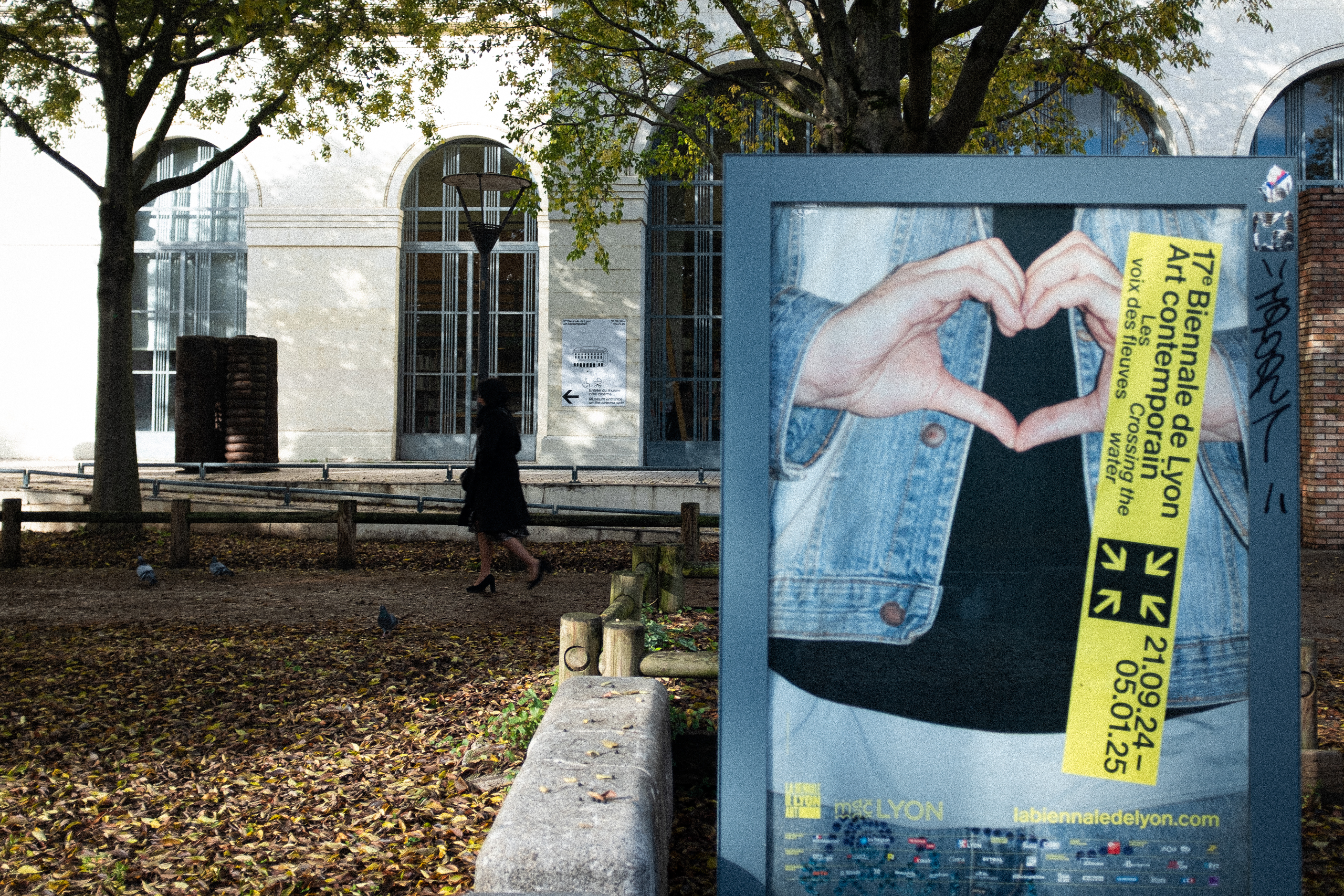
We would like to present to you a photography essay documenting the 17th Lyon Biennale: Les voix des fleuves, Crossing the water. The first instalment centres on one of the main venues at the Musée d’Art contemporain de Lyon (macLYON). Designed by Renzo Piano, the museum initially opened its doors in 1984 before relocating in 1995 to the Cité Internationale, an extensive architectural development positioned between the Rhône River and Tête d’Or Park.
Please refer to the following chapters for the rest of the essay: La Presqu’île; Les Grandes Locos; Institut d’art contemporain de Villeurbanne.
Stepping out of Lyon–Part-Dieu, the stench of piss in the air and cloying, shitty perfume hits you immediately like a slap in the face. Locals striding past with permanently furrowed brows; tourists with their 65-litre backpacks strapped to the backs and another 30 up front like overpacked mules; Riders on scooters calmly weave through it all, balancing a cigarette in one hand and a coffee in the other. Rubbish overflowing from virtually every single bin — voilà, you’re in France.
This is the second time I’ve set foot in the city of Lyon. The first was seven years ago, in a warm, sunlit April, back then we had just wrapped up our project for the St-Étienne Biennale, and a couple of the boys and I took a quick train ride around noon from that quiet town into the city. We were sipping a chilled glass of Sauvignon Blanc, enjoying a classic tripes à la lyonnaise near the Vieux Lyon by the Saône River. People had their sunglasses out, with beaming smiles on their faces that seemed to require no effort at all. Whereas today, it feels like a drastically different organism altogether, like I have just flipped into the Upside Down. Faces have hardened, trees are turning yellow with scattered foliage everywhere, the sky is grey, and the chilling rain cuts straight to the bone. How strange that is, a city can remain the same on a map, yet the entire atmosphere changes the moment the season breaks.
For many kids growing up in the 80s and 90s in Asia, there was this, automatic fascination with, and aspirations toward the West, Europe especially. The mysterious spiky castles, the grey cobblestone streets, houses with slanted roofs tiled in every shade of colour, Christmas lights, and the idea of eating a thick chunk of bloody steak with a knife and a fork, swirling a glass of red at the table while a blonde girl or boy with deep mesmerising blue eyes sat across from you. A whole book of romantic imaginings with curiosity and fantasy written all over the pages.
In my childhood years, whenever my aunt returned from London, I would be dying to eat those Toblerone and Loacker Quadratini she brought back, almost ceremoniously, savouring every last crumb, it was just unlike anything I had ever tasted back then, to me, they were out of this world — they were from the West. I would follow my aunt from room to room, telling her everything I knew to try to impress this distant relative who lived elsewhere, in the West, being the only one in the family. I also remember when my mother had the opportunity to visit Europe, I would urge, demanding she photograph and print out everything she saw, all the sights, whatever scenery, I kept all those photos with me, looking at them over and over again, to a point where certain images were morphing into familiar places I felt I had already visited. And of course, there was the bragging part too.
So when my mother later asked me if I wanted to be sent abroad to the UK for studies, I said yes in a heartbeat. That was the destination, that was the dream of a thirteen-year-old who had never walked outside Chinese borders, even though it meant leaving family and friends, and whatever version of myself existed back then behind.
Now, slowly turning 40 myself, having lived and travelled across Europe for some twenty-odd years, and fast-forwarding through another five-plus years in the Land of the Rising Sun, returning now to France in a cold, bleak November post-COVID, it becomes apparent, that it’s not only the years and the seasons that have changed.
The baguettes bite like jaw-muscle training, a couple of days in, you could feel the tension and the muscles aching; trains are hopelessly delayed at the slightest dusting of snow; millions of cigarette butts are permanently glued to the train tracks; Wi-Fi fails more often than it works, and houses look as if they’re on the verge of collapse with their decaying façades. Once perceived and imagined, in the eyes of an Asian boy, as a spirited and elegant young man, full of style, brimming with confidence and momentum, destined to age slowly and gracefully over many many years to come, Europe now already looks more like a war-torn, frail, ugly cranky bastard with a fat bloated belly, far far removed from a wise old sage, always impatient, endlessly whinging about life, yet doing very little to change it.
That feeling lingered and permeated, quietly seeped into everything, carrying through to my visit to the Biennale at the macLYON on my first day.
In order to get to Lyon-Part-Dieu, the city’s main train station, mind if I add, all it took was a minor pilgrimage on the Eurostar from London to Gare du Nord in Paris, a transfer via the crowded, chaotic, last-century Paris Metro, whether the ticket barrier chooses to respond and flash the gates open is a pure matter of chance, regardless of how religiously you hold your phone against it; then on to the cavernous Paris Gare de Lyon, before one final two-hour train ride down south. Just as you were about to breathe a sigh of relief for making the train on time, a group of hoodies and sweatpants piled into the carriage with their disgusting laughter, and you just knew, this was going to be a serene and pleasant journey, much like riding the Shinkansen from Nagoya westward to Hiroshima and beyond. By the time you arrive in Lyon, night has already fallen. Good luck finding your Airbnb as you squint down at Google Maps on an empty stomach in the dead of winter, all while keeping one eye out for pickpockets and another for phone snatchers.
No, it wasn’t pleasant, are you kidding. And I have to say, it wasn’t easy. Not at all, despite my years of experience travelling around Europe. In fact, getting to a biennale has never been an easy task, domestic or otherwise. It means miles upon miles on the road, jostling through the crowds while trying to actually take in the artworks, figuring out what needs to be photographed and jotting down notes into your phone — layering it all with an amalgamation of fatigue, irritation and frustration, along with a constant undercurrent of emotional overload nagging at the back of your head that’s impossible to shut off, at some point, you just can’t help but wonder: what the actual fuck am I even doing here?
Enough with the whining, that’s more than long enough for an introduction, and for the sake of it, I should still utter a few words about the Biennale itself.


Established in 1991, the Lyon Biennale sits among some of the longest-standing bi- and triennales in the world. Entitled Les voix des fleuves, Crossing the water, where the first part literally translates as “the voices of the rivers”, which somewhat reminded me of a rather underwhelming art project that took place in Nagoya, Japan, in 2022 titled, Streaming Heritage: Between the Plateaus and the Sea. Both projects utilise a river cutting through the city as the backbone of the exhibitions, the latter pivots more toward tourism promotion and area revitalisation, whereas the former employs the river as a metaphor for exchange as well as the nurturing of relationships between individuals. That in turn leads us to the theme of the Biennale, to quote the curator: “… to interrogate and to investigate the subject of the waxing and waning relationships of human beings with one another and with their environment.”


Grumblings aside, the Biennale was great in the sense that the production was executed brilliantly and everything else was handled professionally, likely to some of the highest standards, ticking all boxes, from the curation of some excellent works of global artists, to community practices that embrace localism, getting volunteers involved and all that — beautiful narrative, truly.
In macLYON, Nadav Kander photographs a family of five in Chongqing, China, having a Sunday lunch at a dining table set beside the Yangtze River, a culturally immense and geographic wonder that stretches roughly 6,300 kilometres across the country from west to east. Resonating well with the broader theme and title of the Biennale, it is a brilliant start, tinged with humour and a subtle absurdity through a Western lens. The work is thoughtfully set against the photographic works by Chinese artist Dan Luo, shown in a nearby hall and created in 2006, the same year as Kander’s, which observe two generations living at the edge of the Yangtze near the Three Gorges area in Hubei. The images are a fine attempt to grapple with the overwhelming scale of the river and the surrounding rural landscape, through a far more intimate perspective.


Drawing on personal memories, Taysir Batniji’s Disruptions (2015–2017) is a series of pixelated, frozen screenshots taken from interrupted WhatsApp video calls between the artist and his family in Gaza. In an ostensibly hyper-developed modern digital space, with AI looming above everyone’s heads, human connections, albeit intimate, remain rather fragile. Batniji’s stories are further elaborated in Al-Anqâa (The Phénix) (2024), where viewers are invited into an installation set in a pitch-dark room, in which fluorescent lines trace the map of Gaza across the floor. The work renders the city’s traumatic experience shaped by prolonged power outages and widespread destruction.


Stumbling upon Le Voyage de Noces (The Honeymoon) (1975) is, at first, a pleasant surprise. The autobiographical mural installation, composed of 21 drawings and 86 photographs created collaboratively by Annette Messager and Christian Boltanski, grants viewers a rare opportunity to peer into the couple’s overtly private and personal honeymoon trip to Venice. However, the work, produced in 1975, feels unmistakably like a relic from a distant past, well removed from the couple’s best works. The whole thing’s idea is elevated to leaning into the clichés of Venice as the city of love, undermining conventional ideas of romance and intimacy, “questioning the commonplace assumptions about love relationships.”
Well. I personally see none of those.
Although aesthetically exquisite, capturing a moment in time elegantly, if one strips away its art-historical framing and context, many of the images could easily pass for souvenir goods. In today’s world, where millions of similar images and drawings are uploaded to social media on a daily basis, exhibiting this work in a biennale in the year of 2024, further highlights how names and reputations sometimes can speak much louder than the quality of the work itself, exactly like the celebrity culture that dominates today. In that sense, I guess the work does still speak relevance.


Chantal Akerman’s black-and-white video work In the Mirror, based on her film L’enfant aimé ou je joue à être une femme mariée (The Beloved Child, or I Play at Being a Married Woman) (1971), closes up on a woman confronting and criticising her reflection, while Lyz Parayzo’s Cuir Mouvement (2024) takes the form of suspended metal sculptures shaped like jagged, circular saws that oscillate between danger and protection, in a room devoured by pink illumination entirely. Both works examine the relationship one has with oneself, despite the different mediums and eras of the artists, revealing how one’s own body becomes a site of internalised judgement as well as resistance under social pressures.
Around 25 artists exhibited their works at macLYON, many of whom live in France. Without detailing each one of the works, the exhibitions at the venue focus in particular on “the human relations between friends, families or lovers”, extending also to one’s relationship with oneself. The wide array of artworks apparently justifies and corresponds well to the overall theme, but did it cause any ripple in the heart? I’m afraid not — a shiver at best. Everything was played extremely safe, it neither sought to experiment nor to provoke, it stayed within the boundaries of political correctness, to a degree where it feels like everything was simply, just there, like a dull picture hanging in a kitchen, to please visitors and for them to snap a billion I-was-here pictures for social media.


The thought that clouded my head during my visit, was none other than why the human race needs quite this much mediocrity of art, together with the global sprawl of art fairs, biennales, triennales, exhibitions, events and projects, the amount of boring art projects being produced is beyond staggering. Restaurants and food, yes I get that, we as a human race love to chew on fat and indulge, given our pathetically short lifespan, but tens of thousands of art projects on a globalised scale, annually? Come on already.
Without a shadow of a doubt, biennales do draw people to a city, or even help revitalise some rundown town, Setouchi and Echigo-Tsumari are textbook examples. Whether the Venice model can be copied and pasted onto every single city, and whether it keeps the local economy sustainably afloat and all the hotels booked — I’m not sure. But simply consider that, and often without many realising it, the sheer amount of effort and the substantial finance it takes to actually realise an art project, the enormous production, the logistics and coordination, the materials and time and human resources that have to be poured in, not even mentioning more than half of it will end up in a dumpster once the project concludes, all while the world outside grows visibly much shittier as days go by. Numerous wars are breaking out, actual wars — civil wars, international wars, a pervasive erosion of global peace, rising geopolitical and economic tensions, underlying structural issues like an ageing population and outmigration, must I go on?


2025 is right around the corner, and the world is deeply locked into in a shitstorm, and I wish that maybe, just maybe, one of the artists presenting at these biennales could explain to me why humanity needs so much art right now. But I guess it doesn’t truly matter to them as long as the invoices are cleared and the paycheques arrive on time. “Art is life”, that’s still a motto I wholeheartedly swear by, however, at this point in time, perhaps it’s time we examine life from some other perspectives, something has to change.
I arrived in Lyon with the noble intention of looking at art, and left each day doing something, well, let’s just say humble and sincere. After walking through rooms and rooms of largely forgettable and mediocre art (except for Oliver Beer’s Resonance Project shown at the Grandes Locos), the second I stepped out of the exhibition venues, I hit Google Maps and searched for bouchons. The only thing I craved was not another blasé concept statement that I’d already read a million times elsewhere, and frankly written a hundred myself, nor another pointless installation to “immerse” myself in; I needed something warm, something red, and something reassuring, a reminder that I was still alive and well, amid the shit of a world we are all living in today.
Because restaurants and food, unlike so much of what I had just seen, do not pretend to question the world, it merely nourishes, and sometimes, that’s more than enough. And if there is one thing left that this grumpy old fart still knows, and knows well, it is the unpretentious mastery of a well-cooked meal and a properly poured glass of wine. For now, at least, that feels like true wisdom.